(01) — Case study
A research-driven mobile platform for local job matching and community service access—later adapted into a focused AI-assisted hackathon concept.
(02) — Overview
KONEKTADO helps residents discover nearby workers, services and community opportunities through a structured mobile experience.
The original system was developed as a team academic research project. It combines location-aware discovery, client and provider roles, barangay verification, skill-proof review and community trust signals. KONEKTADO AI came later as a separate hackathon adaptation of the same product idea.
Identity · Konektado DS v1
(03) — See KONEKTADO AI in action
KONEKTADO AI · Hackathon adaptation · 02:28A focused hackathon concept demo built from the research project’s matching problem.
The demo shows the KONEKTADO AI track: a resident describes a need in conversational Taglish, the request is interpreted, and nearby providers are surfaced. It is presented separately from the broader research system.
(04) — Live app
Running at konektado.app.
The frame beside this is the deployed build, loaded live at mobile width—not a screenshot. Some flows need an account, and a few require the native mobile app, so the preview is best used to look at structure, hierarchy and the design system in place.
If the live app declines to be embedded, open it in a new tab instead.
konektado.app ↗Connecting
The problem
Finding trustworthy local help still depends on personal referrals, neighborhood group chats and social posts that the right nearby provider may never see.
Availability, distance and service fit are difficult to compare across informal posts.
Skills are often self-declared, while accountability and work history are scattered or absent.
Skilled residents can remain invisible to clients who already need their help nearby.
Residents may not know which workers or services already exist inside their own community.
(06) — Research foundation
The research system serves clients and service providers without splitting one person into separate accounts.
Residents can browse services, compare nearby providers, review trust indicators and connect with a suitable worker.
Residents can declare offered services, submit proof of skill or experience and discover relevant local opportunities.
One profile can hold both client and provider roles because people naturally hire for one task while offering another skill.
The active role changes recommendations, actions, navigation emphasis and the content shown on the home screen.
(07) — Product experience
The full research journey moves from identity and role setup into structured discovery and trust-aware decision-making.
Create an account, choose an initial role and complete role-specific onboarding.
Set a location and declare service needs, offered skills, experience or supporting proof.
Browse nearby services, providers, job opportunities or client requests based on the active role.
Review profiles, verification signals, work history and relevance before connecting.
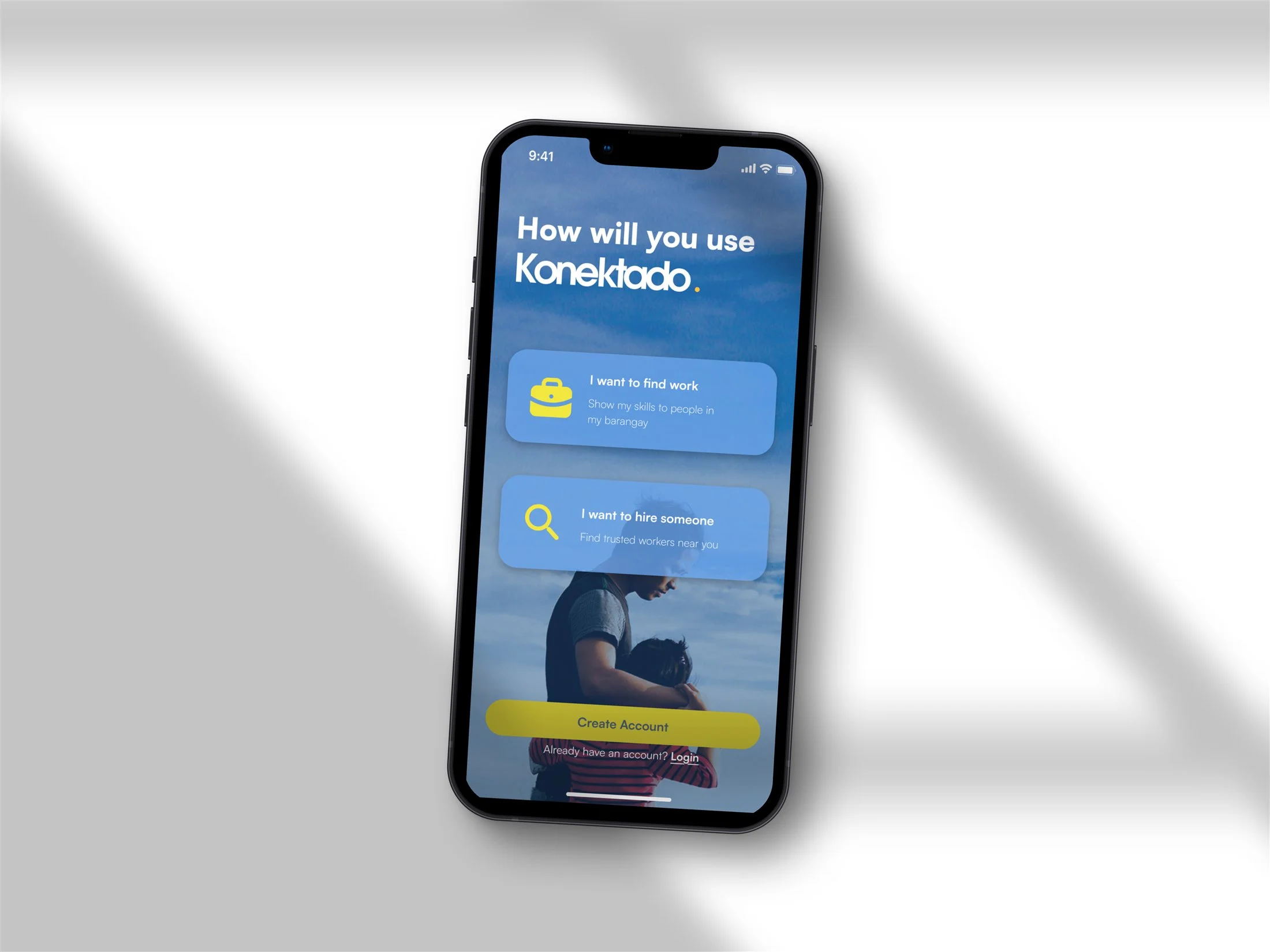
(08) — Research system mockups
Role-aware entry points and local opportunity discovery translated into a mobile interface.
These mockups show the broader research-system track, kept separate from the focused KONEKTADO AI hackathon demo.

(09) — Trust is layered
KONEKTADO does not treat a single badge as proof that someone is safe or qualified for every kind of work.
Barangay and identity verification establishes that a provider is a legitimate community member.
Certificates, work photos, experience and portfolio evidence are reviewed separately from identity.
Qualifications can be self-declared, proof submitted, experience reviewed or certificate verified. Rejections stay private.
Higher-risk services can require stronger proof or credentials than low-risk community tasks.
Completed work, reviews and service history add context over time without becoming an absolute guarantee.
(10) — Matching and discovery
The research version starts with structured data before any broader matching layer.
Home and local services, learning and digital help, and skilled technical services create consistent categories.
Client needs and provider offerings resolve through shared services while the active role shapes what appears.
Proximity improves the relevance of provider discovery, opportunities and service availability.
Verification, experience, reputation and work history help users evaluate a relevant match.
(11) — Technical architecture
A shared mobile and backend model keeps identity unified while allowing each role to expose different capabilities.
Expo, React Native and TypeScript power the role-aware application.
Supabase provides authentication, PostgreSQL, storage and Edge Functions.
Profiles, roles, provider profiles, services, offerings, client needs, verification submissions, jobs, reviews and location data.
Figma, GitHub, AI-assisted development tools and Resend support design, collaboration and communication.
From research to hackathon
While developing the research system, I recognized that its service-matching problem could become a focused AI experience.
I proposed the adaptation to our adviser. After approval, our team reframed the concept for competition presentation as KONEKTADO AI—preserving the local-help problem while condensing the journey around one demonstrable interaction.
I identified the hackathon opportunity, pitched the adaptation and helped translate the broader product into an AI-centered concept.
Describe a need → interpret intent → identify a service → rank nearby providers → review recommendations.
The concept accepts English, Filipino, Taglish and everyday phrasing rather than requiring users to know a service category first.
Service relevance, distance, availability, verification, experience and reputation can inform the recommended order.
(13) — What changed
The two tracks share one origin but serve different goals and should not be presented as the same implementation.
Academic and long-term in scope, with complete roles, onboarding, structured discovery and a layered verification model. This track prioritizes ecosystem completeness
Competition-focused and visually condensed around natural-language requests and ranked provider recommendations. This track prioritizes pitch clarity and a short end-to-end scenario.
Research concept → product development → hackathon opportunity → adviser proposal → KONEKTADO AI adaptation.
(14) — Challenges
Supporting clients and providers without duplicating identity or turning the application into two disconnected products.
Designing verification that improves accountability while acknowledging that no badge can guarantee service quality or safety.
Keeping service categories broad enough for community work but consistent enough for search and matching.
Separating research requirements from hackathon judging criteria while keeping the core idea recognizable.
Maintaining UI consistency and coordinating product decisions across academic and competition deadlines.
(15) — Outcome
KONEKTADO progressed from a research concept into a working mobile prototype and later became the foundation of an AI-focused hackathon adaptation.
Authentication, backend integration, role-aware onboarding, service structure and provider discovery flows.
A layered approach to residency, skills, experience and community reputation.
A complete presentation of the AI-assisted request and local-provider recommendation concept.
Hands-on experience across mobile development, backend architecture, strategy, trust design and team coordination—without inventing adoption metrics.
(16) — Reflection
KONEKTADO taught me that building a product is not only about implementing screens.
The harder work was deciding how users should trust one another, which information should influence a match, how different roles should share one system, and how the same concept must change when presented for research, real-world use or competition. It also showed me the value of recognizing when an existing idea can open a new opportunity.
Visit konektado.app ↗